Kathmandu, May 08– Capital flows into Emerging Market and Developing Economies (EMDEs), particularly within South Asia, have witnessed a marked slowdown since mid-2024. This trend reflects a wider global shift in investment sentiment amidst tightening monetary policies and heightened geopolitical risks. According to the World Bank and the IMF, both net foreign direct investment (FDI) inflows and remittance inflows have experienced significant shifts, which bear direct implications for countries like India, Sri Lanka, Nepal, Bangladesh, and Pakistan.
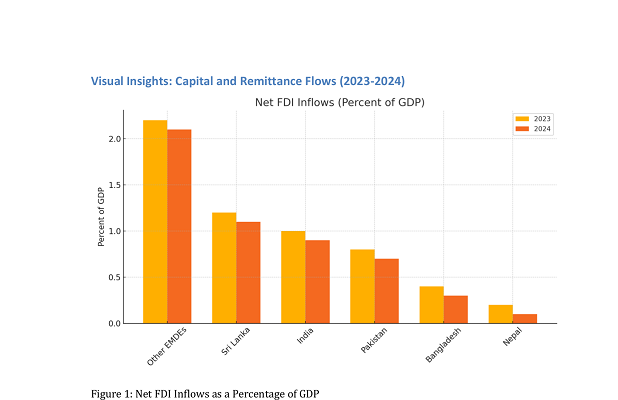
Net FDI inflows, measured as a percentage of GDP, declined across most South Asian economies in 2024 compared to 2023. While EMDEs overall continued to attract investment at relatively higher levels (above 2% of GDP), countries such as Nepal, Bangladesh, and Pakistan recorded substantially lower FDI inflows, below 1% of GDP. India and Sri Lanka fared better, with inflows above 1%, yet still trailed the broader EMDE average. This pattern indicates investor caution amid regional and domestic challenges, including regulatory uncertainties, macroeconomic instability, and weak infrastructure support.
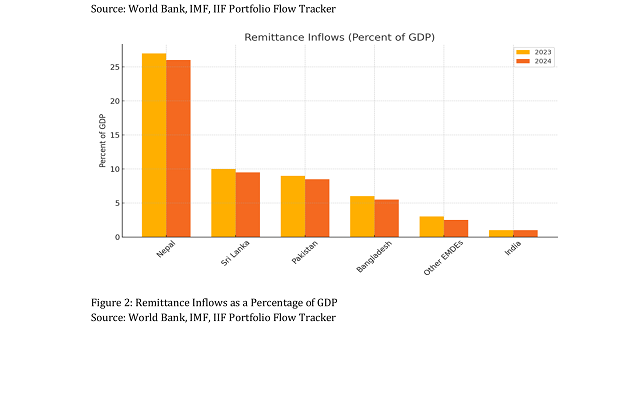
Conversely, remittance inflows remain a resilient source of foreign exchange for South Asia. Nepal stood out, with remittances contributing over 25% of its GDP in both 2023 and 2024, underscoring the importance of its diaspora in supporting the national economy. Sri Lanka and Pakistan also saw significant remittance contributions, well above the average for EMDEs. Bangladesh followed with a moderate share, while India reported the lowest remittance inflows relative to GDP among the group, though in absolute terms, it remains one of the top remittance-receiving countries globally.
These contrasting trends highlight a dual reality: while capital investment is volatile and sensitive to global financial conditions, remittances offer more stable and consistent inflows, often cushioning vulnerable economies from external shocks. For policymakers, this underscores the need to create more favorable environments for FDI—through reforms, transparency, and incentives—while also enhancing systems that facilitate and secure remittance channels for migrants and their families.
As South Asia navigates a complex global financial environment, a balanced approach to strengthening both capital investment and remittance reliance will be crucial to long-term economic sustainability and inclusive growth.